Month-End Close Intelligence
The close is 72 hours.
The variance hunt
is 60 of them.
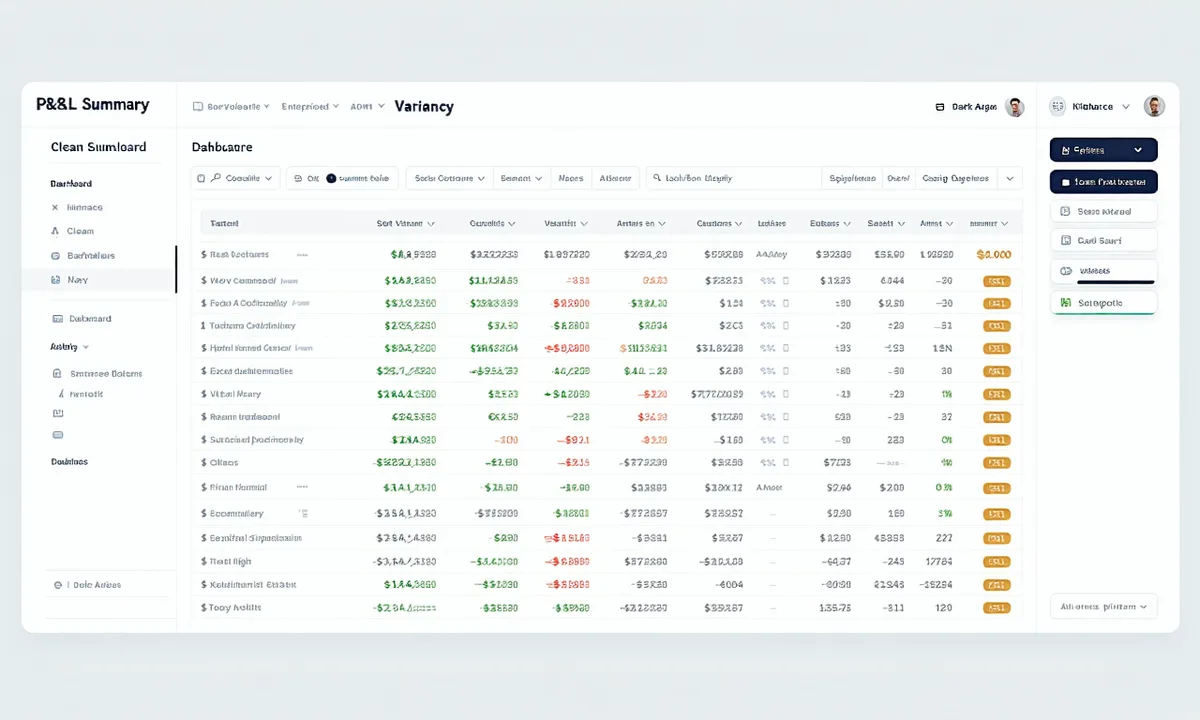
Upload the actuals export. Finwren maps variance drivers line by line, surfaces the account explaining the EBITDA swing, and delivers annotated narrative sections — before the board deck goes into assembly Friday.
| Account | Budget | Actual | Var $ | Var % |
|---|---|---|---|---|
| Net Revenue | $4,820K | $4,763K | –$57K | –1.2% |
| Cost of Revenue | $1,446K | $1,381K | +$65K | +4.5% |
| Gross Profit | $3,374K | $3,382K | +$8K | +0.2% |
| SG&A driver | $1,190K | $1,332K | –$142K | –11.9% |
| EBITDA | $2,184K | $2,050K | –$134K | –6.1% |
01
Month-end actuals ingested
ERP exports, QuickBooks, NetSuite, Excel — Finwren maps the schema automatically
02
Variance attributed with driver label
Account-level attribution, not just summary totals — headcount, volume, accruals
03
Board narrative sections ready
Paste-ready paragraphs with the anticipated board question, before the deck locks
The FP&A Friday Problem
The close is 72 hours. The variance hunt is 60 of them.
Every close cycle, FP&A teams spend the bulk of their time on data reconstruction — pulling actuals from the GL, reformatting ERP exports, building the budget-vs-actual pivot by hand. The analysis that requires judgment — the variance story the CFO will present to the board — gets written in the last two hours before the deck locks.
Pull actuals from the ERP or GL — export, reformat, reconcile entities, check for missing accruals
Build the budget-vs-actual pivot — map account names across systems, compute the variance deltas manually
Chase every line that moved materially — email department heads, wait for context, reconcile answers
Draft the board narrative — translate variances into sentences the CFO can say in the meeting
Deck due in two hours — slides are open, driver attribution is still incomplete
The attribution layer
What Finwren delivers when the actuals export arrives
How it works
From actuals export to attributed variance — one session
Connect your actuals
Upload an ERP export, Excel file, QuickBooks P&L report, or NetSuite subledger pull. Finwren maps account names, period columns, and budget-vs-actual structure automatically — no reformatting required.
Finwren maps variance drivers
Line by line, not just totals. Each account that moved versus budget receives a driver label — headcount, accrual timing, volume, or pricing. The account explaining the majority of the EBITDA variance is surfaced first.
Narrative ready for the deck
Annotated paragraphs paired with each material variance: driver, quantified delta, and the question the board will ask. Ready to paste into the deck before the meeting starts — not written in the cab on the way to the office.
What it does
Purpose-built for the close cycle. Not a full FP&A platform.
Variance Attribution
Identifies what drove the movement, not just the delta amount. Driver categories — headcount, accrual timing, volume mix, pricing — appear at the account level, not just the summary line.
Cash-Flow Scanning
Receivables aging, payables timing, and inventory-build shifts surface alongside the P&L variance — no separate operating cash-flow model to run before the board meeting.
Primary Driver Isolation
The account explaining the majority of the EBITDA or gross margin variance is ranked to the top of the output. Stop chasing 15 line items when one line item is the story.
Board Narrative Prep
Annotated paragraphs for each material variance — driver labeled, delta quantified, anticipated board question surfaced. Ready for the deck, not a draft to start from.
Close Checklist Integration
Variance status ties to your existing close checklist. Each line is marked explained or pending follow-up — so the close sign-off and the variance narrative stay synchronized.
ERP-Agnostic Ingestion
Excel workbooks, QuickBooks P&L exports, NetSuite saved searches, CSV flat files — Finwren reads what you already produce at month-end. No native ERP connector required at the Analyst or Team tier.
Who it's for
The same variance analysis. What it means depends on where you sit.
FP&A Analyst
Stop rebuilding the budget-vs-actual pivot every close.
Two days of data reconstruction — ERP exports, schema reconciliation, pivot tables — before the analysis that requires judgment even begins. Finwren runs the attribution layer so you start with drivers, not deltas.
FP&A TeamsCFO Office
Board deck narrative before Friday 4pm.
The board expects a coherent story about what moved and why. Finwren delivers annotated variance sections with the anticipated board questions already framed — so the CFO reviews a narrative, not a table of raw deltas.
CFO OfficeController / Close Team
From locked actuals to attributed variance — same session.
Books closed is not the same as variance explained. Finwren runs the attribution pass once the actuals are locked, so the close file includes the driver map — not a placeholder for later analysis.
Monthly CloseFrom the field
From FP&A practitioners
Close week used to mean two days of pivot-rebuilding before I could touch the board narrative. The ERP export, the account mapping, the budget-vs-actual build — all of it. Now the attribution output is there when the actuals file arrives. Those hours go to the analysis that actually requires judgment.
Maya Ostrowski
Head of FP&A, Thornwick Group
Our CFO's first question after close is always "what's the SG&A story" — and for a long time, the honest answer was "we're working on it." Finwren surfaces the driver label in the same session the actuals arrive. The question gets answered in the close, not in a follow-up meeting two days later.
Carlos Medina
VP Finance, Saltmarsh Ventures
Financial data requires a different security posture
Run the attribution pass on your last close — in one session.
Upload the actuals export. Finwren returns a driver-labeled variance map. No ERP integration required to start.